


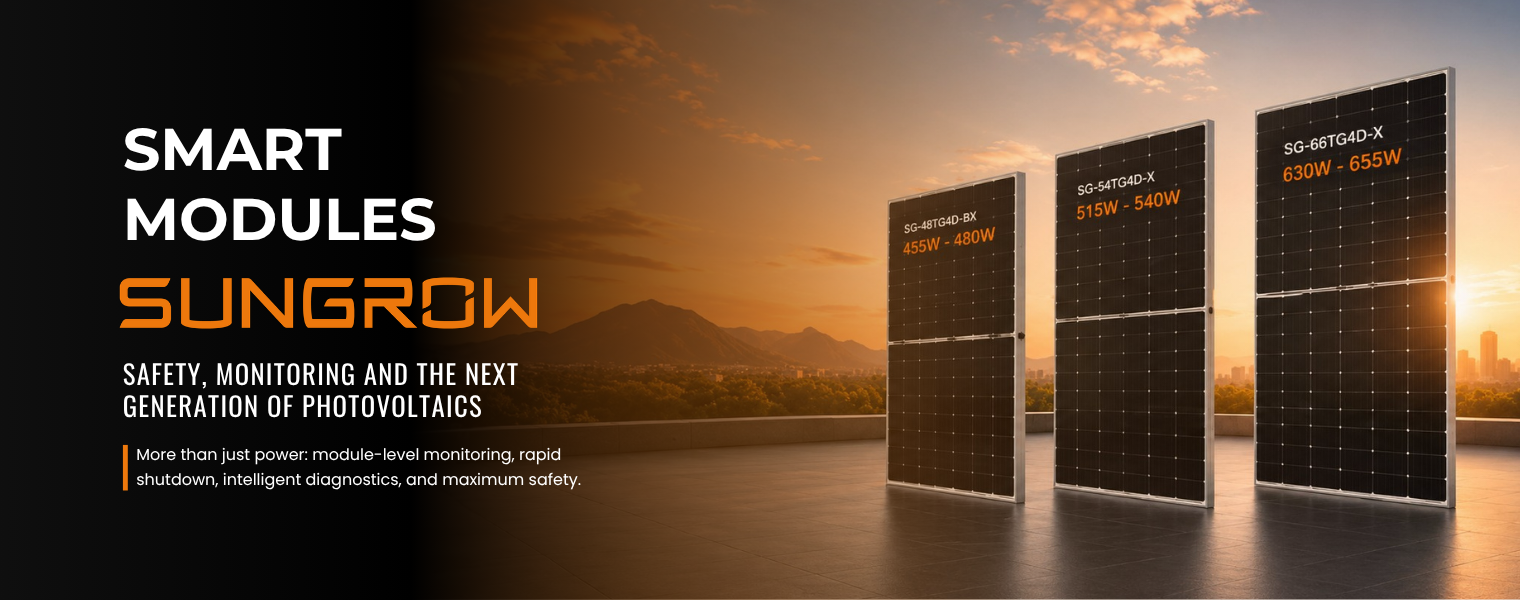
Sungrow Smart Modules: safety, monitoring and a new generation of photovoltaics
The evolution of the photovoltaic sector is no longer measured only in watts. For years, the technological race among solar module manufacturers has focused on increasing power, improving efficiency, reducing degradation and extending warranties. All these factors remain important, but the market is now entering a more advanced phase: that of the smart photovoltaic module.
The new Sungrow smart modules SG-48TG4D-BX, SG-54TG4D-X and SG-66TG4D-X represent this transition. They are not limited to generating solar energy; they also incorporate functions focused on monitoring, electrical safety, fault location and system traceability.
This new generation of solar panels introduces a relevant change for installers, engineering companies, operation and maintenance teams and photovoltaic system owners. The module is no longer just a passive component within the plant. It starts to provide useful information for diagnosis, supervision and technical system management.
In this article, we analyse the main features of Sungrow smart modules, their technical differences, their possible applications and the role this type of technology may play in the future of residential, commercial, industrial and utility-scale photovoltaic installations.
What are Sungrow smart modules?
A conventional photovoltaic module converts solar radiation into electrical energy, but it offers limited visibility into its individual behaviour. In many systems, monitoring is carried out at string, inverter or plant level, which can make it difficult to accurately detect problems in a specific panel.
A smart module goes one step further. In addition to producing energy, it incorporates communication, supervision or response functions for certain anomalies. In the case of the Sungrow models, they include functions such as module-level monitoring, data visualisation through iSolarCloud, rapid shutdown, PLC communication, fault location, precision bypass and digital lifecycle records, depending on the model.
In its official communication about the Smart Module range, Sungrow links this technology to a 5S architecture based on functions such as self-diagnosis, self-rapid shutdown, self-logging, self-cleaning and self-cooling.
The main idea is clear: the solar panel is evolving towards a more digital, safer and more integrated component within the overall operation of the photovoltaic installation.
Why this technology is relevant for the photovoltaic sector
The maturity of the photovoltaic market is shifting part of the value from the module’s nominal power towards the operation, safety and traceability of the installation.
In residential projects, end customers increasingly seek more information, control and safety. In commercial and industrial installations, the priority is usually profitability, system availability and the reduction of incidents. In large-scale plants, operation and maintenance costs can have a direct impact on the financial performance of the asset.
In this context, technologies such as module-level monitoring, rapid shutdown, PLC communication and fault location may play a growing role. They do not replace proper electrical design, correct installation or adequate maintenance by themselves, but they provide an additional layer of information and control.
The importance of these modules does not lie only in their efficiency, but in their ability to improve the operational visibility of the installation.
Comparative table of Sungrow smart modules
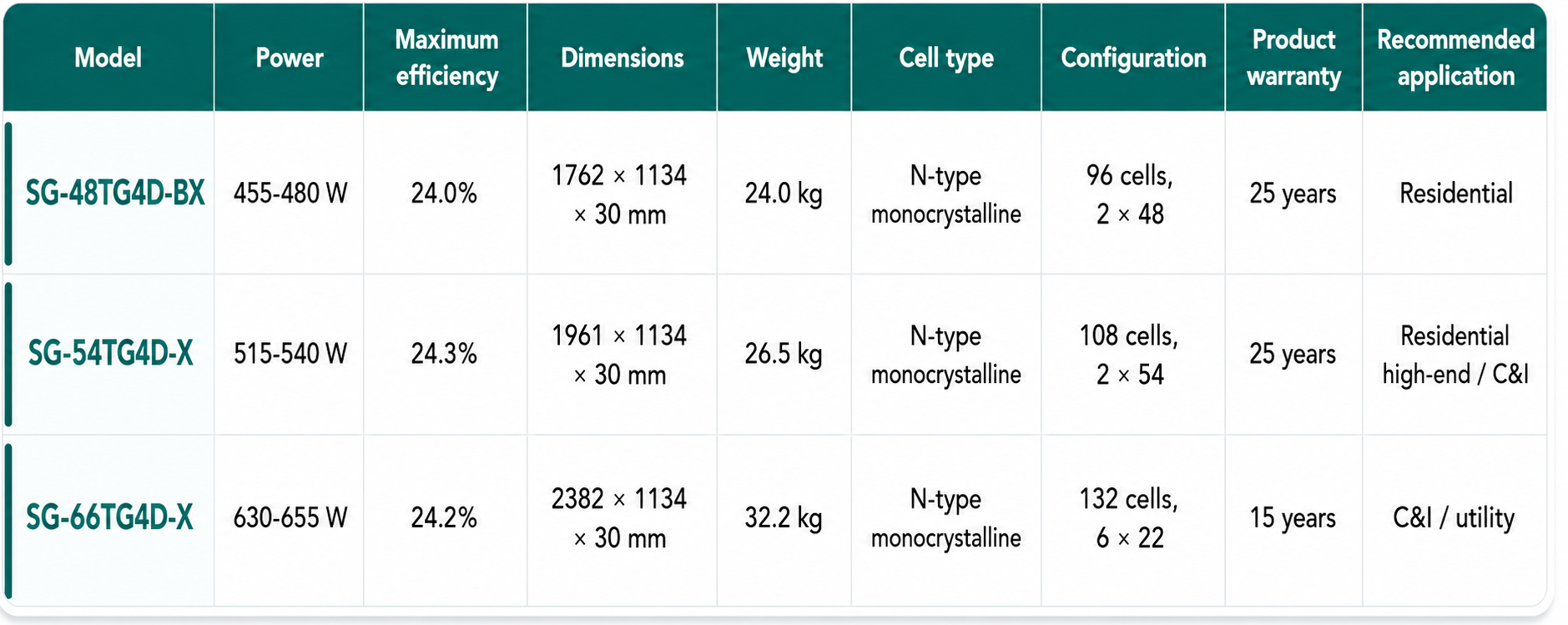
The three models share a series of relevant technical characteristics. They are all bifacial double-glass modules with N-type monocrystalline cells, an 80 ± 5% bifacial factor, a maximum system voltage of 1500 V DC, a maximum series fuse rating of 30 A and an operating temperature range from -40 ºC to +70 ºC.
They also share a mechanical load of 5400 Pa on the front side and 2400 Pa on the rear side, as well as a 30-year linear power output warranty. The datasheets indicate first-year degradation below 1% and annual degradation below 0.4% from years 2 to 30, with a guaranteed power output of 87.4% at the end of the power warranty period.
Technical analysis of the Sungrow SG-48TG4D-BX 455-480W
The SG-48TG4D-BX is the most compact module among the three models analysed. With a power range from 455 to 480 W and a maximum efficiency of 24.0%, it is mainly aimed at residential installations or projects where format, weight and ease of handling are important factors.
Its dimensions are 1762 × 1134 × 30 mm and its weight is 24.0 kg. This format is more manageable than larger modules, which can be relevant for residential roofs, single-family homes or installations with more limited access.
In its 480 W version, the module has a maximum power voltage of 31.75 V and a maximum power current of 15.12 A. Its open-circuit voltage is 36.83 V and its short-circuit current reaches 16.02 A.
Under BNPI conditions, with front irradiance of 1000 W/m² and rear irradiance of 135 W/m², the 480 W model can reach 528 W. This figure reflects the potential of bifaciality when the installation design allows reflected radiation on the rear side of the module to be used.
The datasheet indicates smart functions such as module-level monitoring, data storage and visualisation through iSolarCloud, anomaly detection, shutdown in a time equal to or less than 25 seconds, Smart Pathfinding for fault location and precision bypass, as well as digital lifecycle records.
From a technical point of view, this model can be particularly interesting for residential projects seeking a combination of efficiency, safety and advanced panel-level supervision.
Technical analysis of the Sungrow SG-54TG4D-X 515-540W
The SG-54TG4D-X is the most balanced model in the range analysed. With power ratings between 515 and 540 W and a maximum efficiency of 24.3%, it offers a very interesting relationship between power, size and application.
Its dimensions are 1961 × 1134 × 30 mm and its weight is 26.5 kg. This places it at an intermediate point between the compact residential format and larger high-power modules designed for commercial, industrial or utility-scale installations.
In the 540 W version, the module operates with a maximum power voltage of 35.63 V and a maximum power current of 15.16 A. The open-circuit voltage is 41.50 V and the short-circuit current reaches 16.13 A.
Under BNPI conditions, the 540 W model can reach a power output of 594 W. As with the other models, this value is associated with the use of rear-side irradiance in a bifacial module.
The maximum efficiency of 24.3% is the highest among the three modules analysed. In projects where available surface area is limited, this figure can be especially relevant, as it allows more power to be installed per square metre.
The SG-54TG4D-X datasheet highlights module-level monitoring, data storage and visualisation through iSolarCloud, Rapid Shutdown with a shutdown time equal to or less than 25 seconds, Smart Pathfinding for fault location and precision bypass, as well as Arc Fault Response with anomaly detection and automatic shutdown.
This last point is particularly important. Arc faults are one of the relevant electrical risks in DC photovoltaic systems. The ability to detect anomalies and activate an automatic response strengthens the positioning of this module within the field of electrical safety.
Thanks to its balance between power, size and smart functions, the SG-54TG4D-X can be suitable for high-consumption homes, light industrial self-consumption, commercial rooftops and advanced technical projects without moving into large-format modules.
Technical analysis of the Sungrow SG-66TG4D-X 630-655W
The SG-66TG4D-X is the highest-power module among the three. With a range of 630 to 655 W and a maximum efficiency of 24.2%, it is mainly aimed at commercial, industrial and utility-scale projects.
Its dimensions are 2382 × 1134 × 30 mm and its weight is 32.2 kg. It is therefore a large-format module. This type of panel makes it possible to reduce the total number of modules required to reach a certain installed capacity, although it also requires proper planning in terms of logistics, handling, mounting structure, installation and electrical design.
In its 655 W version, the module operates with a maximum power voltage of 43.5 V and a maximum power current of 15.12 A. The open-circuit voltage is 51.70 V and the short-circuit current reaches 16.04 A.
Under BNPI conditions, the power output can reach 721 W. This figure is especially relevant in projects where bifaciality can be used through reflective surfaces, adequate height above the roof or structures that favour rear-side irradiance.
The datasheet includes module-level monitoring, data storage and visualisation through iSolarCloud, system-level response with anomaly detection and shutdown in a time equal to or less than 25 seconds, Smart Pathfinding, digital lifecycle records and a Self-cleaning function aimed at increasing energy generation.
The Self-cleaning function should be interpreted with caution. It does not mean that the module completely eliminates the need for cleaning or maintenance, but rather that it incorporates a feature aimed at reducing losses associated with dirt accumulation, according to the information available in the product documentation.
Unlike the SG-48TG4D-BX and SG-54TG4D-X models, which declare a 25-year product warranty, the SG-66TG4D-X indicates a 15-year product warranty. The power output warranty, however, remains 30 years.
Smart functions: what they really provide
Module-level monitoring
Module-level monitoring makes it possible to analyse the individual behaviour of each panel. This represents a significant improvement compared with systems where information is obtained only at string or inverter level.
For installers and maintenance companies, this capability can help detect localised losses, modules with abnormal production or incidents that are not always evident in aggregated monitoring.
In an installation with many panels, knowing which module is showing irregular behaviour can reduce diagnosis time and make intervention more precise.
iSolarCloud and data visualisation
iSolarCloud acts as a data storage and visualisation platform. Integration with a digital platform makes it possible to centralise production and system status information.
For the end customer, this can translate into a better understanding of how their installation works. For the installer or maintenance provider, it can provide useful information for monitoring, analysis and incident resolution.
Rapid shutdown
The three modules analysed include RSD parameters. The shutdown output voltage is 1 ± 0.1 V and the rapid shutdown time is equal to or less than 25 seconds.
This figure is especially relevant for rooftop safety, maintenance work and emergency interventions. In a photovoltaic installation, modules can continue to generate voltage while receiving irradiance. The ability to reduce voltage at module level improves electrical risk control.
Smart Pathfinding and fault location
Smart Pathfinding is a function aimed at fault location and precision bypass.
From an operational point of view, this functionality can help identify the source of an anomaly more quickly. In commercial, industrial or large-scale projects, reducing the time needed to locate an incident can have a direct impact on operation and maintenance costs.
Precision bypass
Precision bypass is related to the system’s ability to manage certain operating problems in a more localised way. In practical terms, it can help limit the impact of a specific incident on the overall behaviour of the installation.
It should not automatically be confused with full independent MPPT optimisation at module level, unless the specific system documentation expressly states so. It is important to distinguish between bypass, monitoring, rapid shutdown and energy optimisation, as they are different technical functions.
Digital lifecycle records
Digital lifecycle records provide traceability. In a market increasingly demanding in terms of warranties, performance and asset control, having historical module data can be an advantage for the technical management of the installation.
This information can help document module behaviour, analyse incidents and improve transparency between manufacturer, distributor, installer, maintenance provider and system owner.
PLC communication
Sungrow smart modules use PLC communication. This means that communication is carried out through the power line, avoiding the need for additional communication cabling in many cases.
A maximum communication distance of up to 450 metres is indicated. This figure must be taken into account in system design, especially on large rooftops or projects with long electrical runs.
Smart modules vs optimisers and microinverters: different approaches
The arrival of Sungrow smart modules is part of a broader trend in the photovoltaic sector: bringing more control, safety and monitoring capacity to the level of the solar panel itself.
Until now, many of these functions have been achieved through external devices, such as power optimisers or microinverters. These solutions allow operation at module level, improve shade management, monitor the individual performance of each panel and increase the electrical safety of the installation.
Sungrow’s proposal introduces a different approach: integrating certain smart functions directly into the photovoltaic module. Instead of adding intelligence only through an external device, the panel itself incorporates capabilities such as module-level monitoring, rapid shutdown, PLC communication, fault location, precision bypass and digital lifecycle records.
This does not mean that one solution is always better than another. Optimisers and microinverters still make sense in certain projects, especially when there are complex shading conditions, multiple orientations, design limitations or specific needs for independent optimisation.
However, smart modules open up an interesting path for projects where a more direct integration between generation, safety, diagnosis and traceability is required.
For installers and engineering companies, the key difference lies in system design. A conventional module depends to a greater extent on external equipment to provide intelligence at panel level. A smart module, on the other hand, is designed with part of that functionality integrated from the outset.
This evolution can be especially relevant in installations where traceability, faster diagnosis, rooftop safety and reduced maintenance times are important factors. Rather than automatically replacing other architectures, smart modules expand the options available for designing more controlled, safer and easier-to-monitor photovoltaic systems.
Advantages for installers, engineering companies and system owners
Advantages for installers
For installers, one of the main advantages of this type of module is improved operational visibility. Access to module-level information facilitates incident detection and allows them to offer customers a more controlled installation.
In addition, functions such as rapid shutdown or fault location can add value in projects where safety and maintenance are differentiating arguments.
Advantages for engineering companies and EPCs
For engineering companies and EPCs, smart modules can be interesting in projects where the design must consider not only initial generation, but also the behaviour of the asset throughout its entire service life.
Monitoring, traceability and diagnostic capability can facilitate long-term operation, especially in commercial, industrial or large-scale installations.
Advantages for system owners
For the owner, the main benefit is having more information about the real operation of their photovoltaic installation.
Instead of knowing only the total production of the system, module-level monitoring provides a more detailed view. This can help detect losses, justify maintenance interventions and improve confidence in system performance.
Recommended use cases
Premium residential
The SG-48TG4D-BX can be particularly interesting for residential installations where a compact, efficient solution with advanced safety and monitoring functions is required.
Its more manageable format makes it a suitable option for single-family homes, residential rooftops and projects where module weight and handling are relevant factors.
High-consumption homes and small C&I projects
The SG-54TG4D-X offers a very interesting balance between power, efficiency and size. Its maximum efficiency of 24.3% makes it the most efficient model among the three analysed.
It can be suitable for high-consumption homes, small commercial projects, light industrial self-consumption and rooftops where a high installed capacity is required without using large-format modules.
Industrial rooftops and utility-scale projects
The SG-66TG4D-X is aimed at larger-scale installations. Its power of up to 655 W makes it possible to reduce the total number of modules required to reach a certain installed capacity.
This model can be especially relevant for industrial rooftops, ground-mounted plants or projects where cost per installed watt, logistics, operation and maintenance play an important role in the technical decision.
Differences compared with a conventional photovoltaic module
The difference between a conventional module and a smart module should not be reduced only to power. There are already high-efficiency and high-power modules on the market. The difference lies in the integration of additional safety, diagnosis, communication and traceability functions.
A conventional module generates energy. A smart module generates energy and, in addition, can provide information about its own behaviour.
This difference may seem small, but it is relevant in installations where early problem detection, individual supervision and electrical safety are important aspects.
Not every project necessarily needs a smart module. In simple installations, without relevant shading, with low operational risk and a tight budget, a high-quality conventional module can still be a suitable solution.
However, in projects where safety, maintenance, traceability and supervision play an important role, Sungrow’s proposal opens up an interesting technological path.
A new stage for the photovoltaic module
Sungrow smart modules represent a relevant evolution within the photovoltaic sector. They are not simply high-efficiency solar panels. Their proposal is based on integrating safety, monitoring, diagnosis and traceability functions directly into the module.
The SG-48TG4D-BX, SG-54TG4D-X and SG-66TG4D-X models cover different application segments, from residential to commercial, industrial and utility-scale. They all share a solid technical base: N-type monocrystalline technology, bifaciality, double glass, low degradation, high mechanical load and PLC communication.
The difference lies in the smart layer. Module-level monitoring, rapid shutdown, Smart Pathfinding, anomaly detection, precision bypass and digital lifecycle records are functions that point towards a new way of understanding the solar panel: not only as a generator, but as an active component within the photovoltaic plant.
It will still be necessary to see how its commercial availability, real compatibility in different installation scenarios and adoption by installers and engineering companies evolve. However, from a technical perspective, Sungrow Smart Modules mark a clear trend: the future of the photovoltaic module will be more digital, safer and more integrated.
Do you want to stay up to date with new smart photovoltaic solutions?
At Vico Export Solar Energy, we closely follow the evolution of Sungrow smart modules and new technologies applied to self-consumption, C&I projects and large-scale photovoltaic installations.
If you are an installer, engineering company or professional in the sector and would like to receive updated technical information on solar modules, inverters, storage and smart solutions, our team can help you.